
Bio
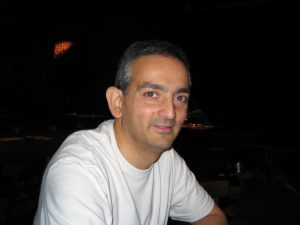
Mark Menezes was born and bred in Birmingham. After qualifying from the University of Manchester in 1988 and passing his professional exams in 1989 he gained an interest in behavioural optometry.
One of his lecturers, Don Loran, knowing Mark’s interest in sport encouraged him to visit Dr Bernard Cassiers, an optometrist in Belgium in order to learn about improving the visual performance of footballers.
Mark visited Dr Cassiers in the Autumn of 1989 and was surprised to find no sports people in Dr Cassiers’ practice. Dr Cassiers explained that the sports people thought that they were good enough already.
Instead the practice was full of children and adults with learning difficulties who had been given a diagnosis of dyslexia, autistic spectrum or some other learning problem. Mark spent a week with Dr Cassiers observing him at work. Mark saw Dr Cassiers use a variety of visually based activities to improve the visual abilities of these patients and so improve their reading, writing and school performance. Mark had no knowledge of these techniques and activities as they had not been mentioned at all at Optometry School.
The following year, Mark went out to Australia where he worked with Graham Peachey the founder of the Australian College of Behavioural Optometrists. Graham Peachey was based in Wodonga on the New South Wales/Victoria state border. Mark would drive down to Melbourne at weekends to spend time with Professor Ed Howell, Head of Binocular Vision at the School of Optometry in Melbourne.
Professor Howell’s practice in Heathmont in Melbourne was only a three hour drive so Mark would set off at six in the morning so that he could spend the day with Professor Howell. Professor Howell would push Mark to test his thinking. Though now semi-retired, Professor Howell still pushes Mark whenever they speak.
Mark then spent eight months living and working with Hans-Peter Abel.
Hans-Peter Abel was the former Head of Binocular Vision at the Berlin School of Optometry and had a practice in Forestville in the northern suburbs of Sydney.
At the same time Mark had the pleasure of meeting Hans-Peter’s father, Peter Abel, the first ever optometrist in Germany.
Mark would spend time talking to both Hans-Peter and Peter Abel about their experiences in optometry.
These experiences included the times they spent with Jim Turville, an English optometrist and Hans-Joachim Haase, a German optometrist both of whom would come to visit the Abel family in Berlin.
Hans-Peter and Peter Abel described Turville and Haase as men of genius.
Mark felt it an honour to spend time in such esteemed company and Hans-Peter and his wife Elvira ensured that Mark improved his rudimentary schoolboy German.
Mark was awarded Fellowship of the Australian College of Behavioural Optometrists in Autumn 1992.
He so became the first UK optometrist to gain an academically recognised qualification in behavioural optometry. Mark subsequently returned to the UK in January 1993.
In fact, in terms of lineage, the principles of behavioural optometry were first devised by Arthur Marten Skeffington, an American optometrist who then taught these principles to a number of people including an optometrist called Gerry Getman.
Gerry Getman then taught Graham Peachey. Graham Peachey in turn was involved in teaching Mark.
Upon his return to the UK, Mark set up an award winning dyslexia clinic in a private practice in Newport in Shropshire, became a Founder member of the British Association of Behavioural Optometrists advising them on education and in the mid-nineties was part of a team that helped set up the first learning disability clinic at an Optometry School in the UK in Manchester.
Mark also taught for over ten years in the dyslexia/binocular clinic at Aston University Optometry School and set up a module of a post-graduate course in Brain Injury Rehabilitation in the School of Psychology at the University of Birmingham.
In recent years Mark has been involved in advising brain injury teams at both the Derby Hospital Brain Injury Unit and a special care unit in Newcastle-upon-Tyne.
Mark has attended post-graduate courses in America run by the Neuro Optometric Rehabilitation Association (NORA) as regarding treatment of brain injury. Mark is working towards their academically recognised Fellowship in Neuro Optometric Rehabilitation.
Mark has had academically recognised papers published as regards the treatment of brain injury and has also attended courses on auditory integration and primitive retained reflexes in order to further his education.
Almost all the patients that come to see Mark have been referred by their schools, educational psychologists, special education teachers or brain injury case managers. Reports from such sources are a prerequisite for making an appointment.
Mark is passionate about ensuring that patients that come to see him in practice get the best help possible to allow them to achieve their potential.